
LIBERATING THE LINE: The Fourth Dimension of Abstraction
Neo Spaziale, 2024
Airplac, plaster, resin, paint, photographic documentation
125 × 75 × 50 cm
360° spatial sculpture, resolved on two executed sides
With Liberating the Line, Neo Spaziale advances a decisive new chapter in the historical evolution of abstraction: the liberation of the line not only into space, but into time as a fourth dimension.
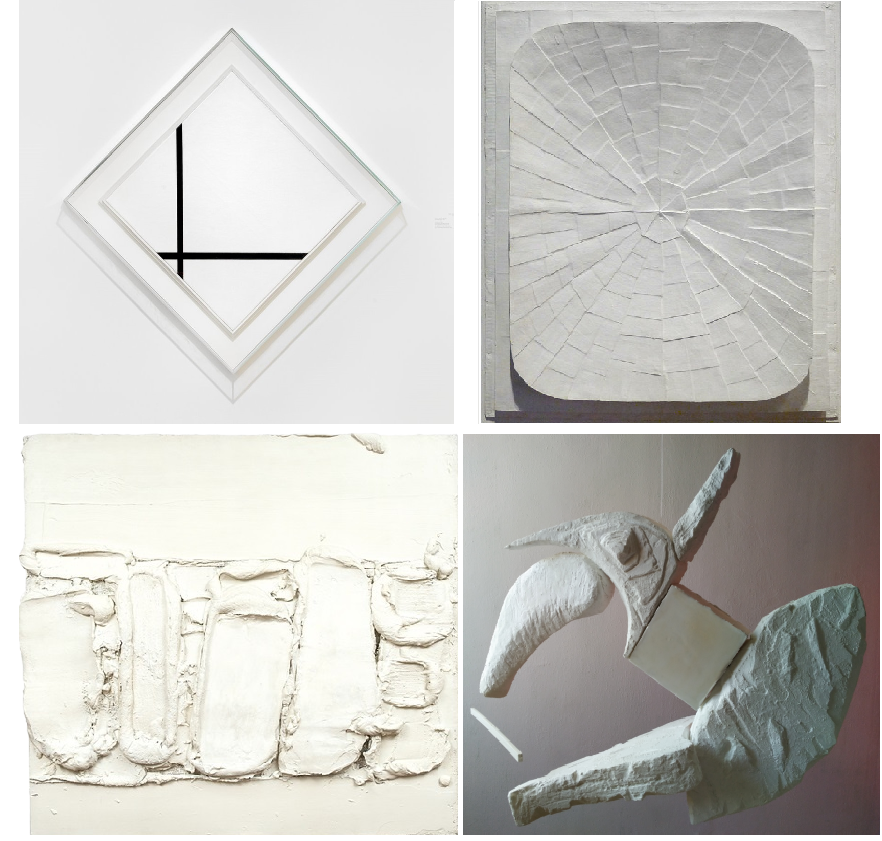
From Piet Mondrian onward, the modern abstract line was emancipated from representation and reduced to a universal principle of order. Yet despite its radical purity, Mondrian’s line remained structurally bound to the static condition of the flat picture plane. Jan Schoonhoven subsequently transformed this geometry into tactile white relief, while Bram Bogart pushed the material density of the surface to its ultimate physical threshold on the wall.
Liberating the Line extends this lineage beyond its last historical limit.
Here, line and plane detach completely from the wall, becoming autonomous sculptural elements suspended freely in space. The work no longer operates within the frontal logic of painting or relief, but unfolds as a fully spatial, 360-degree abstract structure, liberated from the architectural dependency that historically defined the modernist surface.
Its deeper significance, however, lies in a more radical proposition.
This work does not merely continue the transition from two-dimensional abstraction to three-dimensional form; it captures and fixes that evolution as a temporal event.
The sculpture embodies a decisive moment in the historical becoming of abstraction: the instant in which the modernist line is born into free spatial existence. Through its making, suspension, and photographic фиксация, the work consciously anchors this transformation within the fourth dimension of time.
Time here is not contextual—it is constitutive.
The photographic documentation is therefore integral to the work’s ontology. It does not function simply as archival evidence, but as an index of emergence: a visible registration of the birth of a new sculptural condition. The image records the precise historical threshold at which line, plane, matter, and gravity renegotiate their relationship.
In this sense, Liberating the Line operates simultaneously as:
a sculptural object
a historical proposition
a temporal marker
and the origin point of a future evolution whose ultimate trajectory remains open
Its conceptual force lies in the fact that the work preserves the moment of transformation itself.
What was once line as boundary becomes line as body.
What was once plane as containment becomes plane as mobile spatial actor.
What was once timeless modernist order becomes time-conscious abstract becoming.
The work therefore proposes a rare and significant art-historical thesis:
the evolution of abstraction is not complete in space alone; it unfolds through time, and this work captures its moment of liberation.
This temporal fixation gives the sculpture exceptional institutional relevance. For museum collections concerned with the trajectories of De Stijl, ZERO/Nul, matter painting, post-minimal sculpture, and spatial abstraction, Liberating the Line offers not simply an object, but a historically articulated turning point.
It is at once archive, birth certificate, and projection.
Institutional Relevance
Through which it can be placed not only alongside Mondriaan, Schoonhoven, and Bogart, but also in dialogue with:
Marcel Duchamp
Lucio Fontana
Roman Opalka
On Kawara,
Lucio Fontana’s spatial rupture
contemporary sculptural temporality and process-based ontology
The work’s relevance lies in its ability to materialize a missing evolutionary bridge in the history of abstraction:
from painted line, to relief, to matter, to suspended spatial freedom, and finally to time-conscious sculptural becoming.
This positions the work within a lineage that is both historically grounded and forward-looking.